
Client
Own Product
Date
Oct 02, 2017
Author
UC DESIGN LAB
Location
Hong Kong
Background
Daily carry has evolved beyond static needs. Users now manage a mix of devices, documents, and personal items across different contexts—work, transit, and beyond. However, most briefcases remain structurally fixed, offering limited adaptability.
This raised a design question:
Can a briefcase shift from a fixed container into a system that adapts to changing daily needs?
Design Approach
Combo Case is developed with a focus on modularity, adaptability, and material simplicity.
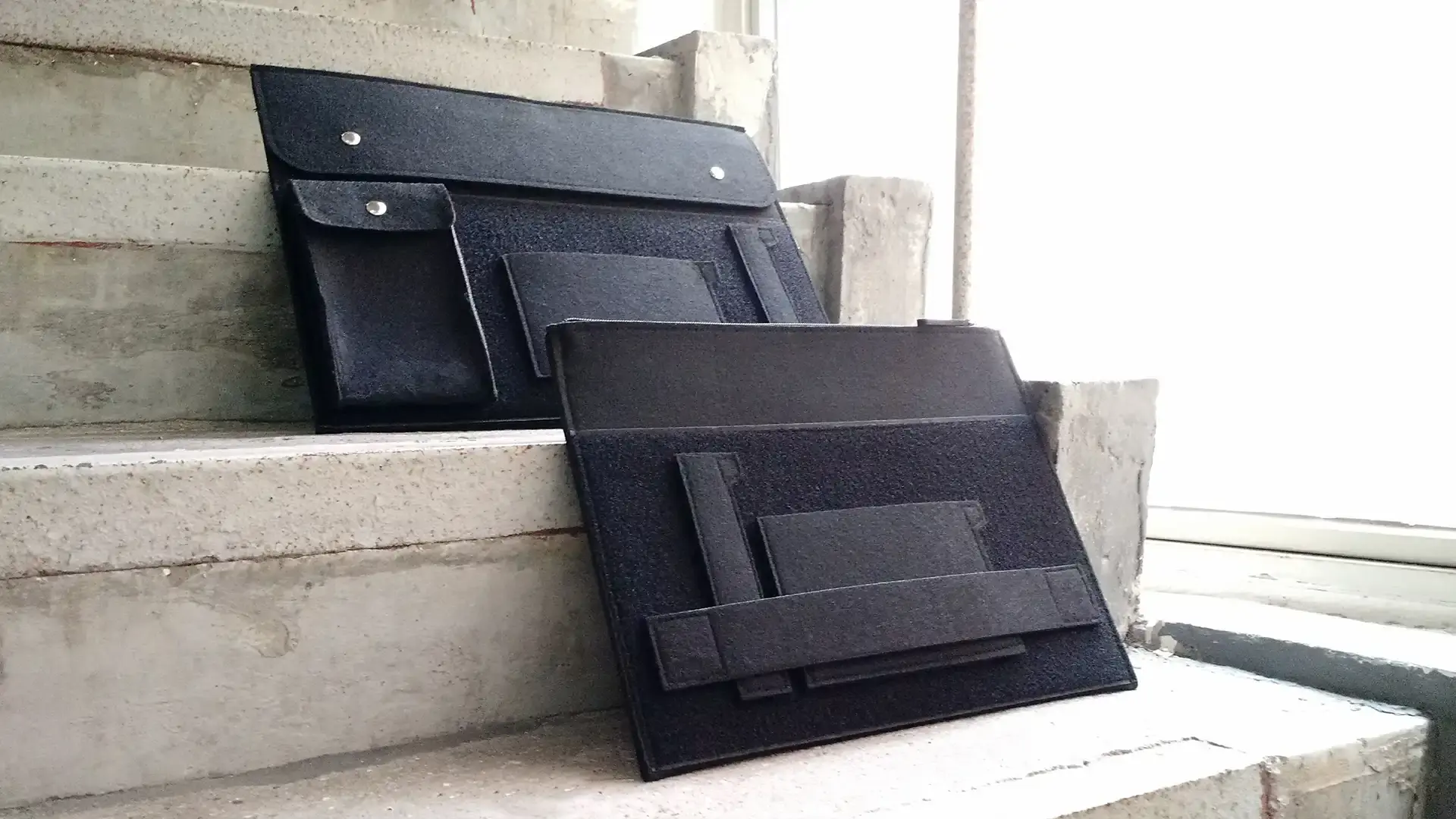
The design uses wool felt combined with a large Velcro interface, allowing components to be freely arranged. Instead of prescribing a fixed layout, the product enables users to configure their own structure based on daily use.
The briefcase becomes less of a static object and more of a flexible framework.
Key Design Decisions
Lightweight and Reduced Form
Minimal structure to support mobility
Suitable for daily commuting and varied usage contexts
Modular Configuration System
Large-area Velcro enables repositioning of components
Interchangeable elements support different setups and styles
Need-Based Organization
Users select and arrange only what they need
Reduces unnecessary bulk and improves efficiency
User Value
Flexible configuration — Adapts to different daily routines
Personal expression — Visual and functional variation through modular parts
Efficient carry — Only carry what is necessary
Balanced design — Protection without rigidity
Conclusion
Combo Case reframes the briefcase as a modular daily system rather than a fixed container.
Through simple materials and flexible structure, it supports a more responsive, personalized way of carrying everyday essentials—aligned with how people move and work today.