
Pet's Furniture
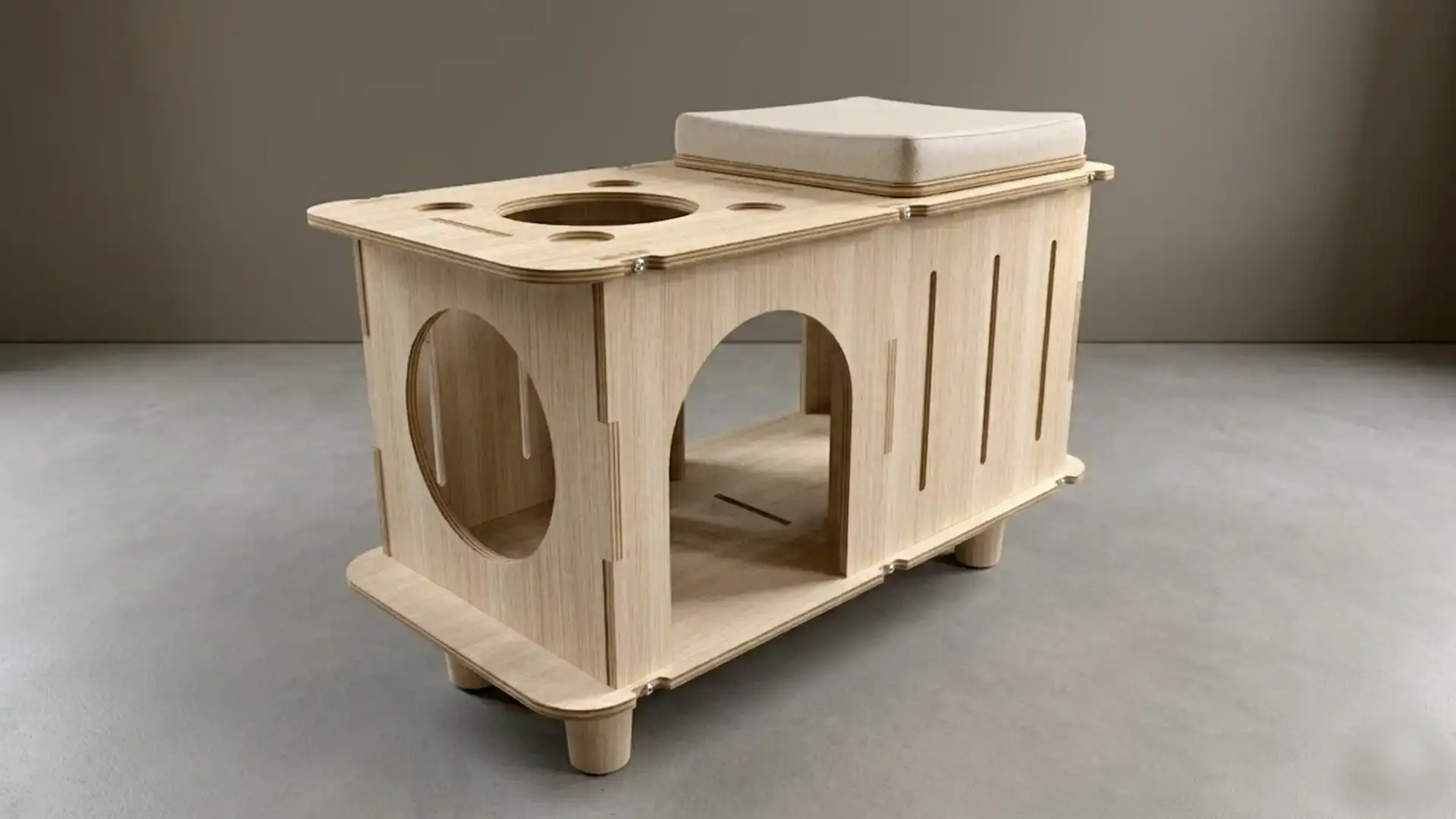
A Modular Furniture System Designed for Both Pets and Humans
Client
Own Product
Date
Mar 01, 2024
Author
UC DESIGN LAB
Location
Hong Kong
Background
As pets become an integral part of modern households, the way living spaces are designed requires reconsideration. Conventional furniture and pet products are often treated separately, resulting in duplicated functions, inefficient use of space, and a lack of visual coherence.
This led to a fundamental design question:
Can a single furniture system support both human and pet needs while maintaining consistency in structure and design language?
Design Approach
This product is built around three core principles: modularity, shared use, and material sustainability.
Using eco-friendly wood and precision laser cutting, each component is designed as part of a standardized system that can be assembled and reconfigured with consistency. Rather than defining fixed functions, the system provides a flexible framework that allows users to adapt configurations based on spatial requirements and daily living patterns.
Furniture is no longer categorized as “for humans” or “for pets,” but instead functions as a shared interface within the living environment.
Key Design Decisions
Shared Usage Logic
A unified structure supports both human and pet interaction
Reduces redundancy by integrating multiple functions into a single system
Modular Configuration System
Components can be assembled, rearranged, and expanded
Adapts to different spatial layouts and usage scenarios
Precision Manufacturing
Laser cutting ensures dimensional accuracy and consistency
Enhances structural stability and ease of assembly
Sustainable Material Selection
Uses environmentally responsible wood materials
Reduces long-term environmental impact
User Value
Spatial integration — A single system serves both human and pet needs
High flexibility — Configurations can evolve with the space
Extended usability — Suitable for rest, activity, and storage functions
Consistent visual language — Improves overall spatial coherence
Conclusion
This project redefines furniture as a shared modular system between humans and pets.
By combining standardized construction with flexible configuration, the design responds to evolving living patterns—where multiple roles coexist within the same space. It shifts furniture from isolated objects into an adaptable framework that supports everyday life as it changes.